Choosing an ocean scuba air tank comes down to more than size alone. Capacity, certification, valve style, and real-world runtime all affect how useful it is in the water.
Below, we focus on compact backup options and full-size cylinders so you can compare the best fit for snorkeling support, emergency use, training, and recreational diving.
Best 10 Ocean Scuba Air Tank Picks for 2026
Compact Backup Air
GOYOJO Mini Scuba Tank, 0.5L Ocean Blue
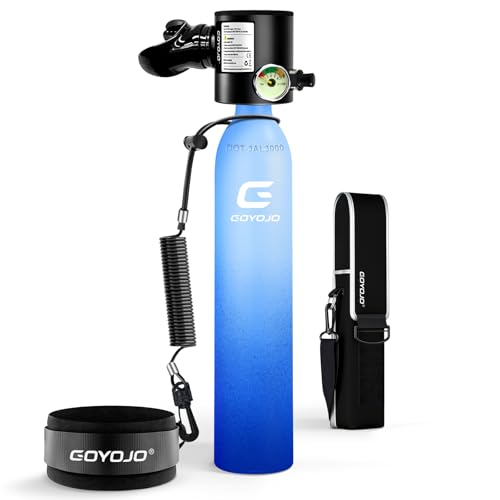
- 0.5L DOT-certified aluminum mini tank
- About 4–8 minutes of breathing time
- Includes regulator, gauge, and accessories
Best For: Snorkeling, pool practice, and emergency backup air
Full-Size Standard Tank
Cyl-Tec Aluminum 80 Scuba Tank Brushed

- 80 cu ft aluminum cylinder at 3000 psi
- Convertible pro-style valve for yoke or DIN
- DOT/TC certified and ships empty
Best For: Standard recreational diving and fill-station use
Portable Mid-Range Kit

- 1L aluminum tank with portable carry bag
- Claims 15–20 minutes at up to 98.43 ft
- Three refill options: adapter, compressor, or pump
Best For: Beginners and casual divers wanting a portable refillable tank
Standard Dive Cylinder
Cyl-Tec S80 Aluminum Scuba Tank

- 80 cu ft aluminum tank at 3000 PSI
- Convertible DIN and yoke valve
- DOT/TC certified and saltwater-ready
Best For: Training, rentals, and everyday recreational diving
Portable Backup Bottle

- 30-40 minutes of listed breathing time
- DOT-certified 6061 aviation aluminum body
- Includes vest, bag, and scuba adapter
Best For: Compact backup air source for short dives and emergency use
Gauge-Equipped Mini Tank
2.3L Mini Scuba Tank with Gauge

- 25-35 minutes of listed dive time
- 30-inch 360-degree expandable pressure gauge
- Three inflation methods supported
Best For: Portable diving with easier air monitoring and flexible refill options
Ultra-Compact Starter Kit
0.5L Portable Scuba Tank with Pump

- About 37 breaths underwater
- Includes pump and diving mask
- DOT/CE certified aluminum build
Best For: Tiny backup kit for brief, travel-friendly use
Compact Safety Backup
SMACO S300 0.5L Mini Scuba Tank
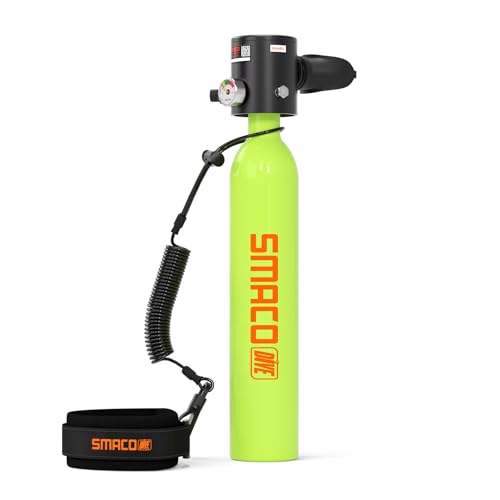
- 0.5L tank with about 35 breaths at 200 bar
- DOT certified with upgraded safety features
- Refillable by dive shop, adapter, compressor, or hand pump
Best For: Shallow-water backup air and travel-friendly emergency use
Beginner-Friendly Shallow Tank
1.0L Mini Scuba Tank for Snorkeling

- 1L capacity with about 75 breaths at 16 ft
- Empty tank only; includes carry bag and valve gear
- Multiple refill options, including dive shop and pump
Best For: Shallow snorkeling, training, and beginner underwater practice
Extended Runtime Travel Pick
SMACO S700 Plus 1.9L Mini Scuba Tank

- 1.9L tank offers about 115 breaths at 200 bar
- Includes pressure gauge, vest, and mesh bag
- Refillable by dive shop, adapter, or air compressor
Best For: Travelers and divers wanting more runtime in a portable kit
Compact Backup Air – GOYOJO Mini Scuba Tank, 0.5L Ocean Blue
If you want an ocean scuba air tank for short recreational use, this GOYOJO mini cylinder is built around portability and backup breathing rather than long-duration diving. The 0.5L aluminum tank is DOT certified, refillable, and designed for snorkeling, pool practice, and emergency extra air when a compact setup makes more sense than a full-size system.
Best For: Snorkelers, pool practice, and divers who want a compact emergency backup air source.
Pros:
- DOT certified 6061 aluminum construction with refillable design
- Built-in fluorescent pressure gauge for quick checks in low light
- Includes regulator, O-ring kit, tank sleeve, and wrist lanyard
- Adjustable airflow and burst valve add practical safety features
Cons:
- Estimated 4–8 minutes of breathing time, so it is not for extended dives
- Empty cylinder only; no inflator or pump included
- Not intended as a primary air supply for deep or prolonged diving
This is a sensible pick if your priority is a small, easy-to-carry backup rather than maximum capacity. It fits the role of a short-use ocean scuba air tank well, but the limited runtime means buyers should treat it as a safety supplement, not a full dive solution.
Full-Size Standard Tank – Cyl-Tec Aluminum 80 Scuba Tank Brushed
For buyers shopping for a traditional ocean scuba air tank, this Cyl-Tec Aluminum 80 is a standard 80 cu ft cylinder with 3000 psi working pressure. It ships empty and DOT/TC certified, and its pro-style valve can convert from yoke to DIN, making it a familiar fit for many recreational diving setups.
Best For: Divers who want a full-size aluminum tank for standard recreational use and fill-station convenience.
Pros:
- Standard 80 cu ft capacity with 3000 psi working pressure
- Convertible pro-style valve supports yoke-to-DIN use
- DOT/TC certified and shipped ready to fill
- Predictable buoyancy figures help with dive planning
Cons:
- Ships empty by law, so it requires a local fill source
- At about 30 pounds, it is far less portable than mini tanks
- Not a compact option for travel-light or emergency-only use
This is the straightforward choice if you want a common, full-size cylinder instead of a specialty compact tank. Its value is in compatibility, capacity, and standard sizing, which makes it a practical baseline option for many divers.
Portable Mid-Range Kit – VEVOR 1L Portable Diving Tank
This VEVOR ocean scuba air tank sits in the middle between tiny backup bottles and full-size cylinders. The 1L aluminum tank is built for portable underwater breathing, with the notes stating 15–20 minutes of use at depths up to 98.43 ft, plus refill options that include an adapter, compressor, or manual high-pressure pump.
Best For: Beginners and casual divers who want a portable refillable tank with more runtime than a mini bottle.
Pros:
- 1L size offers longer use than ultra-compact mini tanks
- Three inflation options add flexibility for refills
- Aviation-grade aluminum construction is corrosion-resistant
- Includes a carry bag for transport and scratch protection
Cons:
- Still limited compared with a full-size scuba cylinder
- Best depth and runtime depend on conditions and breathing rate
- Manual or external inflation equipment may be needed for refills
If you want something more capable than a backup bottle but less bulky than a standard tank, this is a practical compromise. It is aimed at casual exploration and emergency backup use, so it makes sense for buyers who value portability and moderate runtime.
Standard Dive Cylinder – Cyl-Tec S80 Aluminum Scuba Tank
If you are comparing a classic ocean scuba air tank, this Cyl-Tec S80 is built to match the standard setup many divers already know. It offers 3000 PSI and 80 cu ft capacity, a convertible DIN/yoke valve, and DOT/TC certification, making it a familiar full-size aluminum tank for training, rental-style use, or everyday diving.
Best For: Divers who want an industry-standard 80 cu ft tank with broad regulator compatibility.
Pros:
- 80 cu ft capacity and 3000 PSI working pressure
- Convertible DIN/yoke valve improves compatibility
- DOT/TC certified for U.S. and Canada standards
- Corrosion-resistant aluminum construction suits saltwater use
Cons:
- Ships empty and must be filled locally
- Much less portable than mini or 1L tanks
- Designed for standard diving use, not compact travel convenience
This S80 is the most conventional option in the group and makes sense when you want an established tank format instead of a specialty portable cylinder. The main appeal is simple: standard capacity, standard valves, and standard compatibility.
Portable Backup Bottle – 2.3L Scuba Tank with Vest
If you want an ocean scuba air tank that feels practical for short recreational dives, this 2.3L mini cylinder is built around portability and backup breathing time. It offers a DOT-certified aluminum build, comes with a scuba adapter and vest, and is aimed at users who want a compact reserve air source for underwater use.
Best For: Divers who want a compact backup air cylinder for short sessions, snorkeling, or emergency reserve use.
Pros:
- 30-40 minutes of underwater breathing time listed for the 2.3L tank.
- DOT-certified 6061 aviation aluminum body with corrosion resistance.
- Includes a diving vest, hand bag, and scuba adapter for carry and inflation options.
- Portable design can be disassembled for airplane travel.
Cons:
- Air pump is not included, so inflation equipment must be sourced separately if needed.
- Maximum applicable depth is listed at 33 ft, so it is not meant for deeper primary use.
- Weights and setup make it less minimal than the tiniest backup bottles.
Overall, this is a solid choice if your priority is a portable ocean scuba air tank with a longer runtime than micro-size options. The included vest and adapter add convenience, while the safety-focused aluminum construction makes it a sensible pick for backup breathing support.
Gauge-Equipped Mini Tank – 2.3L Mini Scuba Tank with Gauge
This ocean scuba air tank is designed for divers who want a portable 2.3L cylinder with more monitoring convenience. It is DOT-certified, uses aerospace aluminum, and adds a 30-inch expandable pressure gauge so you can check remaining air without moving the tank around.
Best For: Divers who want a portable mini tank with an easier-to-read pressure gauge and multiple inflation options.
Pros:
- 25-35 minutes of listed dive time from the 2.3L, 16 cu ft tank.
- 30-inch expandable pressure gauge rotates 360 degrees for easier checking.
- Supports three inflation methods: air compressor, large-cylinder adapter, or dive shop filling.
- Made from aerospace aluminum with a 5K explosion-proof valve and multi-layer filters.
Cons:
- Not pre-inflated, so setup and inflation are required before use.
- Maximum pressure is capped at 3000 psi.
- Runtime depends on depth and breathing rate, so real-world duration may vary.
For buyers comparing compact ocean scuba air tank options, this one stands out for its gauge setup and flexible refill paths. It is a practical pick if you value convenience and safety features more than extras like a bundled vest or pump.
Ultra-Compact Starter Kit – 0.5L Portable Scuba Tank with Pump
If you need an ultra-compact ocean scuba air tank for very short breathing support, this 0.5L kit focuses on portability and simplicity. It includes a pump, mask, and DOT/CE-certified aluminum tank, making it a lightweight option for learners, emergencies, or brief underwater use.
Best For: Buyers who want a tiny, travel-friendly backup kit for short snorkeling, emergency, or beginner use.
Pros:
- Approximately 37 breaths underwater from the 0.5L tank.
- Includes a pump and diving mask in the kit.
- DOT/CE certified with 6061 aviation aluminum construction.
- Triple-filter system and glow-in-the-dark pressure gauge add usability.
Cons:
- Safety depth is listed at just 5 meters, so it is limited in use.
- Only about 37 breaths, so runtime is very short compared with larger tanks.
- Best suited to brief support rather than extended underwater activity.
This is the most compact option in the group and makes sense if you want a backup air source that packs easily and includes the basics. For serious dive time, larger tanks are more appropriate, but for short sessions and portability, it fills a niche well.
Compact Safety Backup – SMACO S300 0.5L Mini Scuba Tank
If you want an ocean scuba air tank that stays small enough for travel but still gives you a real backup breathing source, the SMACO S300 is built for that role. Its 0.5L aluminum body, DOT certification, and multiple refill options make it a practical choice for shallow recreational use, boat cleaning, and emergency support.
Best For: Divers and travelers who want a compact backup air source for shallow water tasks and short excursions.
Pros:
- About 35 breaths at 200 bar, tested at 16 ft depth
- External explosion-proof device and upgraded breathing valve core
- Three-layer filtration helps block dust and impurities
- Can be refilled at dive shops, with an adapter, compressor, or hand pump
Cons:
- Maximum diving depth is limited to 16 ft for primary use
- 0.5L capacity is very small for extended underwater work
- Hand-pump refilling is the slowest option
The S300 makes sense if your priority is portability and emergency readiness rather than long dive times. It is especially appealing for short dives, boat-side tasks, and anyone who wants a reusable mini tank that can be taken apart for travel.
Beginner-Friendly Shallow Tank – 1.0L Mini Scuba Tank for Snorkeling
This ocean scuba air tank is aimed at shallow diving and easy portability, with a 1.0L capacity and DOT-certified aluminum construction. It comes as an empty tank only, so it works best for buyers who want a reusable breathing setup for snorkeling, training, pool use, or other short underwater tasks.
Best For: Beginners and hobbyists looking for a compact, refillable tank for shallow water exploration and practice.
Pros:
- 1L capacity provides about 75 breaths at 16 ft depth
- Precision air switch valve and constant-pressure regulator for smoother breathing
- Explosion-proof valve vents excess pressure over 5000PSI
- Includes carry bag for transport and storage
Cons:
- Sold as an empty tank only, with no gas included
- Best suited to shallow water rather than deeper dives
- Hand pump refilling takes about 50 minutes
For buyers who want a compact starting point, this tank balances portability, refill flexibility, and straightforward construction. It is a sensible pick if you need a reusable option for short underwater sessions instead of a full-size scuba system.
Extended Runtime Travel Pick – SMACO S700 Plus 1.9L Mini Scuba Tank
If you want an ocean scuba air tank with more usable capacity than the smallest mini bottles, the SMACO S700 Plus is designed for longer shallow-water sessions. Its 1.9L aluminum build, pressure gauge, vest, and mesh bag make it a more complete kit for recreational diving, pool training, and boat-side work.
Best For: Divers who want a larger portable tank kit for shallow recreational use, travel, and backup air.
Pros:
- 1.9L capacity delivers about 115 breaths at 200 bar
- Extended pressure gauge helps check tank pressure underwater
- Includes a vest and mesh bag for carrying and hands-free use
- DOT certified and refillable at dive shops or with an adapter/compressor
Cons:
- High-pressure hand pump cannot fill this model
- Still intended for shallow-water use rather than deep diving
- Larger and heavier than the 0.5L and 1.0L options
This model is the most practical choice here if runtime matters more than absolute size. It offers a better balance of capacity and portability for users who want a reusable mini tank with extra support features.
How We Picked the Best Ocean Scuba Air Tank
For this roundup, we looked at practical factors that matter to real buyers: usable air capacity, portability, DOT or similar certification, reusable construction, and whether the tank is meant for true diving support or short-duration backup breathing. We also considered valve compatibility, advertised depth limits, and how well each option fits common use cases such as boat diving, travel, and emergency reserve air.
Quick Comparison
The main split is between larger aluminum tanks and mini dive cylinders. Larger models like standard 80 cu ft tanks offer far more breathing gas and are better suited to regular scuba use, while compact units are easier to carry and are built for short emergencies, surface support, or limited underwater time. If you want one Ocean Scuba Air Tank for serious dive planning, capacity matters most; if you want a portable backup, weight and refill convenience matter more.
Key Buying Factors for Ocean Scuba Air Tank
Capacity and Runtime
Advertised breathing time can vary a lot based on depth, exertion, and breathing rate. Treat runtime claims as estimates, not guarantees. A 0.5L tank is typically for very short backup use, while 1L to 2.3L mini tanks stretch the available air but are still best viewed as compact emergency or auxiliary cylinders.
Certification and Safety
Look for DOT, TC, or equivalent certification when possible, especially if you plan to transport or refill the tank regularly. Certification does not replace proper training, but it does help indicate a more established manufacturing and inspection standard.
Valve Type and Fill Method
Check whether the tank uses DIN, yoke, or a proprietary setup, and make sure your regulator or filling system matches. Some mini systems are designed around integrated fill adapters or pumps, while standard cylinders usually integrate more easily with dive shop gear.
Portability and Intended Use
A lighter Ocean Scuba Air Tank is easier to stow on a boat, pack for travel, or keep as backup. However, portability often trades off against usable air. Match the tank to your actual dive profile instead of choosing the smallest option available.
Who Should Buy Which Ocean Scuba Air Tank?
Choose a full-size aluminum 80 if you need mainstream scuba capacity for regular recreational diving. Choose a mini tank if you want a compact backup for snorkeling, short underwater checks, training drills, or emergency reserve air. If you are new to this category, prioritize certification, clear runtime expectations, and compatibility with your existing gear before focusing on the smallest or cheapest option.