Moving a fully loaded kayak across gravel, sand, roots, and uneven trails can turn a short carry into the hardest part of the outing. The right cart reduces strain while keeping your boat stable and your gear secure.
We selected 10 kayak carts for rough terrain with an emphasis on load capacity, wheel design, frame adjustability, storage, and practical handling across challenging surfaces.
Best 10 Kayak Carts for Rough Terrain Picks for 2026
Heavy-Duty All-Terrain Pick

- 450 lb aluminum frame capacity
- 12-inch solid all-terrain tires
- Adjustable width and tie-down strap
Best For: Heavy kayaks and uneven launch routes
Quick-Storage Choice
Ulticor Puncture-Proof Kayak Cart

- 260 lb carrying capacity
- Puncture-proof all-terrain wheels
- Tool-free setup and breakdown
Best For: Compact storage and fast preparation
Balanced Aluminum Option

- 300 lb aluminum-frame capacity
- 11-inch no-flat wheels for rough ground
- Padded and adjustable support bars
Best For: Versatile transport across mixed terrain
Simple Sand-and-Gravel Carrier

- 150 lb carrying capacity
- Airless tires for sand and gravel
- Includes two ratchet straps
Best For: Lighter boats and easy storage
Best Heavy-Duty Pick
GanFindX 16-Inch-Wheel Kayak Cart

- 300-pound steel frame
- 16-inch flat-free wheels
- Adjustable frame with foam pads and straps
Best For: Rough paths, gravel, sand, and heavier watercraft
Best Lightweight Aluminum Pick
- 330-pound capacity at 9.3 pounds
- 12-inch solid flat-free wheels
- Adjustable 7- to 22-inch platform
Best For: Portable freshwater or saltwater kayak transport
Best High-Capacity Universal Pick

- 450-pound weight capacity
- 6.3- to 18.7-inch adjustable width
- 12-inch solid wheels with kickstand
Best For: Heavy or varied kayak and canoe hulls
Best with Extra Features
- 350-lb aluminum-alloy load capacity
- 13-inch wheels for sand and grass
- Adjustable, detachable frame with straps
Best For: Heavy kayaks and beach or grass transport
Most Adaptable
Suspenz Catch-All Airless Kayak Cart

- Adjustable bunker bars fit varied hull shapes
- Airless 12-inch wheels resist flats
- Four-point straps improve load stability
Best For: Mixed hull types and flat-resistant transport
Beach Terrain Favorite
Bonnlo Balloon-Wheel Kayak Cart

- 330-lb aluminum construction
- 12-inch balloon wheels suit sand and lawns
- Adjusts from 6.3 to 18.7 inches
Best For: Beach, lawn, and rough-terrain kayak hauling
Heavy-Duty All-Terrain Pick – VEVOR 450 lb Kayak Cart
For kayak carts for rough terrain, the VEVOR stands out with a 450-pound capacity and large 12-inch solid tires. Its aluminum frame, adjustable width, and tie-down strap make it a practical choice for moving larger kayaks, canoes, paddleboards, and similar watercraft across gravel, sand, grass, and uneven paths.
Best For: Heavy watercraft and users who regularly cross uneven launch routes.
Pros:
- Supports up to 450 pounds with a 2mm-thickened aluminum alloy frame.
- 12-inch solid tires require no inflation and are suited to gravel, sand, and grass.
- Adjustable 170–440mm frame width accommodates several types of watercraft.
- Detachable design and upgraded single-foot support simplify storage and parking.
Cons:
- Its 12.1-pound package weight is higher than some compact cart options.
- The supplied notes do not specify whether the wheels are replaceable.
The VEVOR is the strongest-capacity option in this group, making it especially useful when both the load and the terrain are demanding. Its larger wheels and secure strap support add confidence on uneven routes.
Quick-Storage Choice – Ulticor Puncture-Proof Kayak Cart
When shopping for kayak carts for rough terrain, the Ulticor combines puncture-proof wheels with a lightweight, tool-free design. Its adjustable straps, reinforced construction, and kickstand are aimed at keeping a kayak or canoe stable across uneven ground while making the cart easy to store afterward.
Best For: Paddlers who prioritize compact storage and quick setup.
Pros:
- Puncture-proof all-terrain wheels eliminate routine flat-tire concerns.
- Supports watercraft weighing up to 260 pounds.
- Assembles and disassembles within seconds without tools.
- Adjustable straps, hull pads, and a toggle lock help limit shifting.
Cons:
- The 260-pound capacity is lower than the VEVOR’s 450-pound rating.
- Its plastic construction may appeal less to shoppers seeking an aluminum frame.
The Ulticor is a convenient middle-ground cart: durable enough for many kayaks and canoes, but notably focused on portability. Choose it when fast breakdown and flat-free wheels matter more than maximum load capacity.
Balanced Aluminum Option – GanFindX 300 lb Kayak Dolly
The GanFindX is a balanced pick among kayak carts for rough terrain, pairing a 300-pound aluminum frame with 11-inch no-flat wheels. Padded support bars and adjustable spacing help protect and stabilize different hull shapes while moving across grass, gravel, sand, or uneven paths.
Best For: Users wanting a sturdy, portable cart for varied watercraft and outdoor surfaces.
Pros:
- 300-pound capacity supports kayaks, fishing kayaks, canoes, and paddleboards.
- 11-inch solid wheels are designed for grass, gravel, sand, and rough terrain.
- Padded support bars help cushion the hull and reduce scratches.
- Detachable aluminum frame is easier to carry, store, and transport.
Cons:
- The listed product details contain an inconsistent 1E+2-pound load-capacity entry, despite the 300-pound product description.
- Its 11-inch wheels are smaller than the 12-inch wheels on the VEVOR cart.
The GanFindX offers a useful combination of capacity, protective padding, and portability. Verify the capacity details before purchase, but the stated 300-pound rating makes it a versatile choice for many heavier recreational craft.
Simple Sand-and-Gravel Carrier – Bonnlo Foldable Kayak Cart
The Bonnlo is a straightforward option for kayak carts for rough terrain, using 10-inch-wide airless tires that roll across sand and gravel without going flat. Its foldable, tool-free design and included ratchet straps make it convenient for transporting lighter kayaks, canoes, paddleboards, and other watercraft.
Best For: Lighter watercraft and shoppers seeking an easy-to-store carrier.
Pros:
- Airless 10-inch tires resist flats and are designed for sand and gravel.
- 150-pound capacity suits many kayaks, canoes, paddleboards, and float mats.
- Includes two 7.75-foot ratchet straps for securing larger watercraft.
- Assembles and disassembles without tools for convenient storage.
Cons:
- Its 150-pound capacity is the lowest among the carts in this roundup.
- The supplied notes do not identify a specific adjustable-width feature.
The Bonnlo makes sense for moderate loads and users who want a basic carrier that breaks down easily. Its airless tires are particularly practical for sandy or gravelly approaches, though heavier boats require a higher-capacity model.
Best Heavy-Duty Pick – GanFindX 16-Inch-Wheel Kayak Cart
For kayak carts for rough terrain, the GanFindX stands out with a 300-pound steel frame and oversized 16-inch flat-free wheels. Its adjustable frame, foam padding, and included tie-down straps make it a practical choice for moving kayaks, canoes, paddleboards, and other watercraft across uneven paths.
Best For: Paddlers who want a high-capacity cart with large, no-flat wheels for gravel, grass, packed sand, ramps, and rough ground.
Pros:
- Supports up to 300 pounds with a sturdy steel frame.
- 16-inch flat-free wheels are suited to outdoor terrain.
- Adjustable width accommodates different hull shapes.
- Foam support pads and tie-down straps help protect and stabilize the watercraft.
Cons:
- Steel construction is heavier than the aluminum alternatives listed here.
- The supplied notes do not specify the exact adjustment range.
The GanFindX is a strong match when wheel size and terrain capability matter most. It also offers quick setup and compact storage, though its steel build may be less convenient for shoppers prioritizing minimum carry weight.
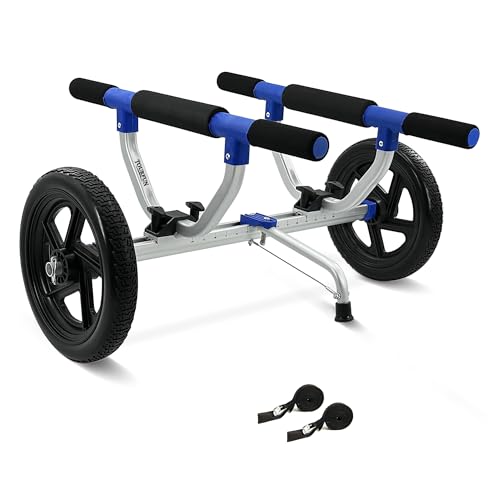
Best Lightweight Aluminum Pick – Airless-Tire Kayak Trolley
This aluminum kayak trolley combines a 330-pound capacity with a relatively light 9.3-pound body. Its 12-inch airless wheels, adjustable platform, kickstand, and corrosion-resistant construction make it a versatile option among kayak carts for rough terrain and regular freshwater or saltwater use.
Best For: Kayakers seeking a lightweight, corrosion-resistant cart with stable loading features and adjustable support for different kayak designs.
Pros:
- Anodized aluminum frame supports up to 330 pounds while weighing 9.3 pounds.
- 12-inch solid, flat-free wheels handle a variety of terrain.
- Adjustable 7- to 22-inch platform width helps accommodate different designs.
- Kickstand and two cinch straps assist with loading and securing the kayak.
Cons:
- Its 12-inch wheels are smaller than the 16-inch wheels on the GanFindX.
- The supplied notes do not identify a specific terrain limitation or wheel tread pattern.
The airless-tire trolley offers a balanced combination of capacity, portability, and adjustability. Its corrosion-resistant aluminum is especially useful for saltwater environments, while the quick-breakdown design helps with storage and transport.
Best High-Capacity Universal Pick – Bonnlo Adjustable Kayak Cart
The Bonnlo kayak cart is designed for demanding loads, with a 450-pound capacity and adjustable 6.3- to 18.7-inch spacing. Its 12-inch solid wheels, padded support bars, and kickstand make it a capable choice for moving different kayaks or canoes across lawns, sand, and rough terrain.
Best For: Owners of heavier or differently shaped kayaks who need broad width adjustment, a high weight rating, and easier loading.
Pros:
- 450-pound capacity suits heavy kayaks and canoes.
- Width adjusts from 6.3 to 18.7 inches, with axle measurement markings.
- 12-inch solid wheels are designed for sand, lawns, and rough terrain.
- Kickstand, padded support bars, two straps, and a two-year warranty add practical value.
Cons:
- At 11.2 pounds, it is heavier than the 9.3-pound aluminum trolley.
- The 12-inch wheels are not as large as the 16-inch wheels on the GanFindX.
The Bonnlo is the most load-focused option in this group and provides unusually broad adjustment for different hulls and keel positions. Choose it when capacity and universal fit are more important than minimizing cart weight.
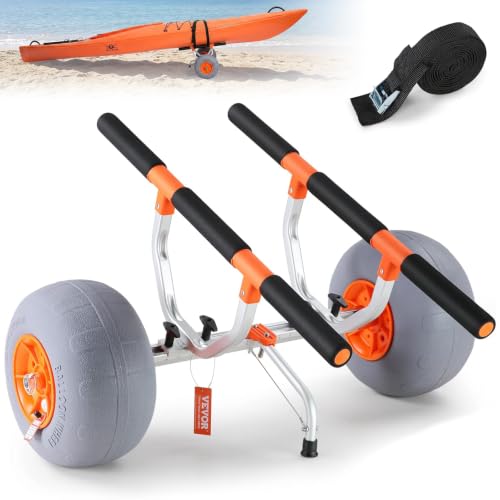
Best with Extra Features – VEVOR 350-lb Kayak Cart
For shoppers comparing kayak carts for rough terrain, the VEVOR stands out with a 350-pound capacity, large 13-inch beach wheels, and an adjustable frame. Its wheels are designed to handle grass and sand, though the manufacturer specifically warns against gravel roads.
Best For: Heavy kayaks, canoes, paddleboards, and beach or grass transport where high capacity matters.
Pros:
- Supports up to 350 pounds with a thickened aluminum-alloy frame.
- 13-inch wheels help absorb shocks across grass and sand.
- Adjustable 170–440 mm frame width suits several watercraft types.
- Detachable, tool-free assembly and included tie-down straps simplify transport.
Cons:
- Not recommended for gravel roads because the tires may break.
- Its 15-pound weight is heavier than some comparable carts.
This is a strong capacity-focused option for uneven beach and lawn approaches, provided your route does not include gravel. The locking foot support and two straps add useful stability on uneven sections.
Most Adaptable – Suspenz Catch-All Airless Kayak Cart
The Suspenz Catch-All is a versatile choice among kayak carts for rough terrain, especially when hull shapes vary. Its adjustable bunker bars, padded 32-inch platform, and airless wheels support multiple loads without the flat-tire concern of pneumatic wheels.
Best For: Paddlers moving tunnel, catamaran, V-shaped, jon, or flat-bottom boats over mixed surfaces.
Pros:
- Bi-directional bunker bars adjust for wide or flat loads.
- 12-inch airless wheels have a 2-inch tread and resist flats.
- Four-point tie-down system helps reduce rocking and shifting.
- Tool-free assembly, storage bag, and no-rust aluminum frame improve portability.
Cons:
- Rated capacity is 300 pounds, lower than some heavy-duty alternatives.
- Optional beach wheels are sold separately.
- Warranty shipping support is limited to the 48 contiguous states.
With a 12-pound frame, low-lift kickstand, and adaptable support bars, this cart balances portability and load stability. It is particularly appealing if avoiding punctures is more important than using balloon-style beach wheels.
Beach Terrain Favorite – Bonnlo Balloon-Wheel Kayak Cart
The Bonnlo is built for shoppers seeking kayak carts for rough terrain with a strong emphasis on sand. Its 12-inch low-pressure balloon wheels, adjustable width, padded support bars, and kickstand make it practical for loading and rolling kayaks across beaches, lawns, and rough terrain.
Best For: Sand, lawn, and rough-terrain transport with a broad range of kayak or canoe widths.
Pros:
- 330-pound capacity from a marine-grade, heat-treated aluminum design.
- Balloon wheels are designed to roll smoothly over sand and other listed surfaces.
- Adjustable bar spacing from 6.3 to 18.7 inches accommodates varied hulls.
- Includes a kickstand, two straps, pump, and two-year warranty.
Cons:
- Balloon tires require inflation and depend on the included pump.
- Its stated terrain coverage does not specifically include gravel roads.
This cart is a well-rounded beach-oriented option, combining a high load rating with wide adjustability. Choose it when soft-surface mobility and easy loading are priorities.
How We Picked These Kayak Carts for Rough Terrain
We focused on the features that matter when a cart must travel beyond smooth pavement: large or wide tires, puncture resistance, a stable support system, adjustable width, useful weight capacity, and a frame that can be stored or transported without excessive hassle. We also considered whether each design suits kayaks, canoes, paddleboards, or mixed watercraft.
Capacity claims should be treated as a starting point rather than a guarantee for every trail. The combined weight of the boat, battery, tackle, cooler, and other equipment affects handling, especially on slopes or soft ground.
Quick Comparison
| Cart type | Best suited to | What to prioritize |
|---|---|---|
| Airless or solid tires | Mixed trails and regular transport | Low maintenance and puncture resistance |
| Balloon beach wheels | Loose sand and beaches | Wide footprint and low sinkage |
| Large pneumatic-style wheels | Roots, gravel, and uneven paths | Wheel diameter and ground clearance |
| Adjustable bunkers or supports | Different hull shapes | Secure fit and non-slip padding |
Key Buying Factors for Kayak Carts for Rough Terrain
Wheel Design
Wheel diameter helps the cart roll over rocks, roots, and ruts, while width matters on sand and soft soil. Solid, airless, and puncture-free wheels eliminate flats, but some can transmit more vibration than air-filled designs. Balloon wheels are especially useful on beaches because they spread the load over a larger area.
Frame Strength and Capacity
Choose a rated capacity comfortably above the fully loaded watercraft’s weight. Aluminum frames are often lighter and resist corrosion, while heavier construction may offer more confidence with large fishing kayaks. Check how the load is distributed across the supports rather than relying on capacity alone.
Fit and Stability
Adjustable width and padded bunkers help the cart accommodate different hulls. A secure strap is essential on uneven ground. Bi-directional supports or shaped cradles can improve contact and reduce shifting while turning or descending a slope.
Portability and Setup
Detachable, foldable, or tool-free designs are easier to keep inside a vehicle or kayak. Confirm the folded dimensions and whether the wheels remain attached during storage. Quick assembly is valuable when the launch is far from the parking area.
Who Should Buy Which Kayak Carts for Rough Terrain?
Choose a solid- or airless-wheel cart if you want minimal maintenance and dependable use on varied terrain. Choose balloon beach wheels when soft sand is the main challenge. Choose larger wheels and higher clearance for rocky paths, roots, and uneven access roads. Choose adjustable bunker bars or width settings if you own multiple boats or frequently carry different hull styles.
Before buying, compare the cart’s width range with your hull, verify the loaded weight, and measure your storage space. For the roughest routes, prioritize stability and wheel performance over the lowest price or lightest frame.